
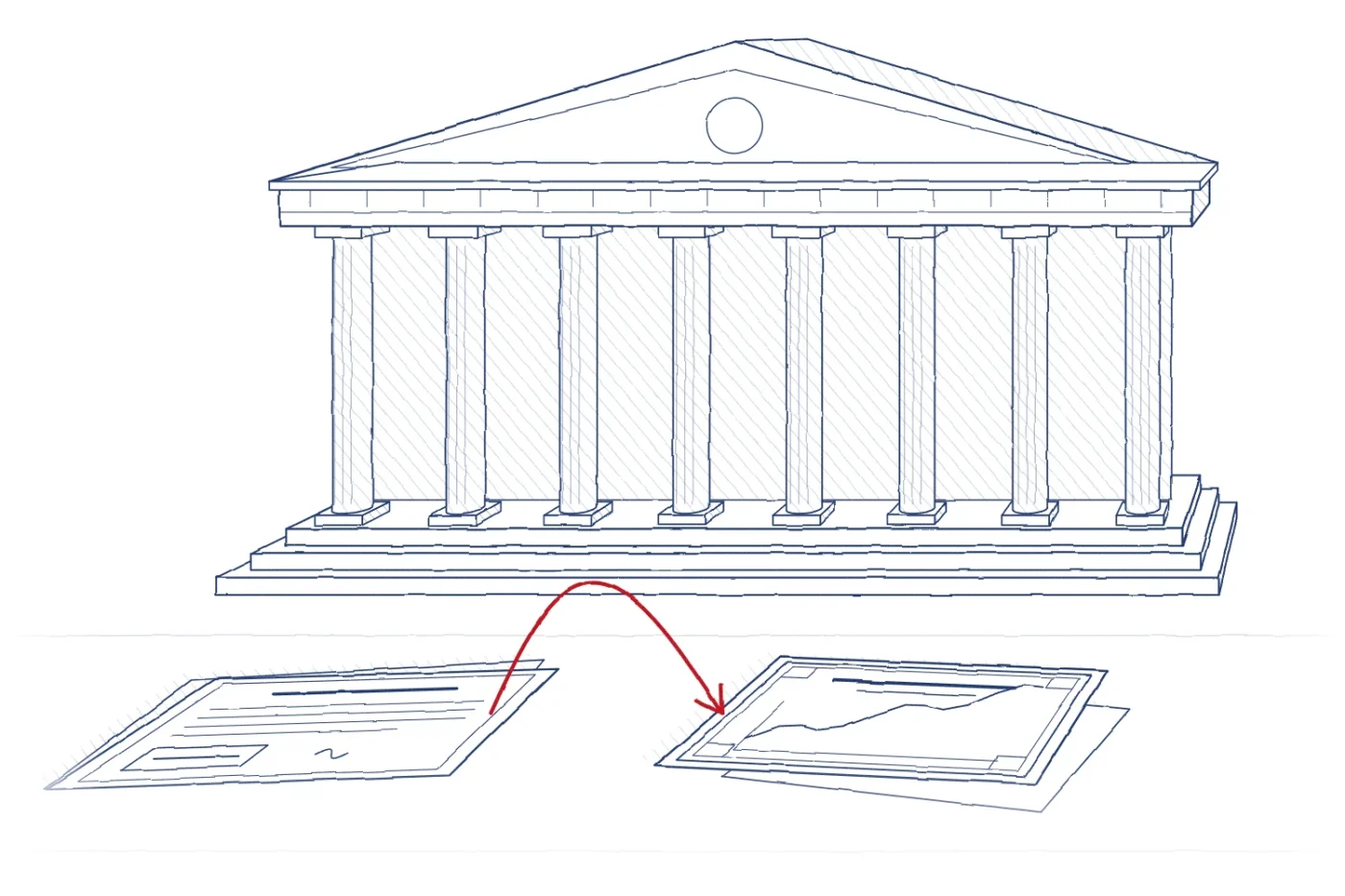
Convert depositary receipts into real shares.
Do you hold ADRs or GDRs of Russian companies? We check whether conversion into ordinary shares is possible and guide you through the entire process.
Without conversion, the worst case is a forced sale on unclear terms. The routes to conversion change regularly – we know them.
- Free initial assessment
- Custody account with our international partners – no trip to Russia
- No transfer of ownership to third parties
- Half of the fee only payable on successful conversion
KODEX Legal · since 1992 · Villa Quistorp, Potsdam · for private and institutional investors
FREE INITIAL ASSESSMENT
NO TRIP TO RUSSIA
50% OF THE FEE ONLY ON SUCCESS
SINCE 1992
FREE WEBINAR · TUESDAY, 10 NOVEMBER 2026 · 3:00 PM (CET) · IN ENGLISH
Russian DRs, forced conversion and dividends
Current procedures, completed projects and litigation options
How are forced conversions of Russian ADRs and GDRs currently handled? What happens to accrued dividends? And what legal options remain if the conversion fails?
In the webinar we report on completed conversion projects, put the current procedures into context and set out litigation options.
Speakers
- Anton Shamatonov, Managing Partner, MAGENTA Legal
- Sven Goltz, Rechtsanwalt (German attorney), KODEX Legal
Free online webinar in English. We will send you the dial-in link by e-mail in good time before the date.
Register now
"*" indicates required fields
THE SITUATION
Why depositary receipts need attention now.
Anyone in Europe who invested in Russian companies usually holds not shares but depositary receipts. Since 2022 this model has come to an end for many companies.
BACKGROUND
Receipts instead of shares.
Russian shares are traded only on the Moscow Exchange. Through ADRs, GDRs and EDRs, investors were nevertheless able to invest via their bank at home.
SINCE 2022
Many programmes terminated.
A Russian law forces many companies to terminate their DR programmes. The depositary receipts must be exchanged for ordinary shares.
THE RISK
Forced sale on unclear terms.
Without conversion, the depositary bank may sell the shares. If many securities come onto the market at the same time, heavy losses are likely.
OUR SERVICE
We guide the conversion – from the assessment to the shares in your account.
Conversion is complicated and often possible only at certain times. Together with our international partners, we keep the effort for you as low as possible.
ASSESSMENT
Is conversion possible?
We review your DR classes, the time of purchase and possible sanctions – and tell you openly what is currently possible.
CUSTODY ACCOUNT
No trip to Russia.
Together with our partners we open a custody account for you and verify it. All share classes can be transferred to this account.
CONVERSION
Instruction, bank, custodian.
We coordinate the conversion instruction with your bank and the custodians. We also support you in claiming dividends.
PROCESS
How we proceed.
1
Initial assessment
You answer a few questions about your depositary receipts in the form and receive an initial assessment immediately.
2
Review & offer
We review your case and contact you by phone or e-mail with the next steps.
3
Custody account & application
Together with our partners we open your custody account and prepare the conversion instruction to your bank.
4
Conversion
In our experience, conversion takes about six to eight weeks. After that, the shares are in your account.
Good to know: Half of our fee is only due on successful conversion. We cannot guarantee conversion because the requirements change regularly. We currently assist with a total value of €75,000 or more. Conversion is currently not possible, among other cases, for sanctioned companies and for depositary receipts acquired after 27 April 2022.
ENQUIRY
Have your conversion assessed free of charge.
Answer a few questions about your depositary receipts. You receive an initial assessment immediately, and we will get in touch with you.
FAQ
Frequently asked questions about ADR and GDR conversion.
What are depositary receipts in the first place?
Depositary receipts (DRs) are certificates representing Russian shares. Because Russian shares can only be traded on the Moscow Exchange, many Russian companies launched depositary receipt programmes. As part of these programmes, European and American banks took Russian shares into custody and issued depositary receipts for them, which could be traded on Western exchanges without regulatory effort. Depending on the exchange on which they are traded, these depositary receipts are referred to as ADRs (American Depositary Receipts), GDRs (Global Depositary Receipts) and in some cases EDRs (European Depositary Receipts).
Do I have to convert my Russian DRs in any case?
Whether you have to convert your Russian depositary receipts depends on your individual investments. Russian companies such as Norilsk Nickel or Tatneft have received special permits to continue their DR programmes. In that case, no immediate action is required. However, it has also been confirmed that trading in DRs of large companies such as Gazprom, Gazprom Neft, Sberbank, Magnit, Lukoil, Mobile TeleSystems, RusHydro, VTB Bank, LSR Group and the Federal Grid Company of Unified Energy System (FGC UES) will be terminated. Further companies are likely to follow on this list. Affected investors therefore need to have their depositary receipts converted into shares if they do not want to risk a forced sale and a total loss of their investment.
Can I simply keep my DRs?
Depositary receipts of companies whose DR programmes are expiring cannot be held forever. The Russian DR programmes expire at different times and must be exchanged for ordinary shares by then. Otherwise they will be sold compulsorily at a price that is currently unknown. The good news for affected investors is that even securities from DR programmes that have already expired can currently still be converted into ordinary shares in some cases. How long this will remain possible, however, is unclear. Quick action is therefore needed.
What happens if I do not convert my Russian DRs?
If you do not convert your Russian depositary receipts into shares in time, the depositary bank concerned will try to sell the underlying shares. Affected investors then receive the sale proceeds less any costs and fees incurred. However, it is currently unclear whether this will be possible because of sanctions. Moreover, even in the event of a sale, there is a risk of an enormous loss of value and, in the worst case, a total loss of the investment, since countless depositary receipts would come onto the market at the same time. Investors from countries such as China or Russia, on the other hand, could profit from the forced sale by buying up Western investors’ securities cheaply.
How much time do I have to convert my Russian depositary receipts?
All conversion deadlines set by Russia have in fact already expired. The good news, however, is that no forced sale of the affected securities has taken place so far, and conversion of depositary receipts into actual shares has in some cases still worked even after a DR programme expired. It is unclear, though, whether and for how long this will remain possible. In addition, conversion is still made more difficult in some cases because European banks, brokers and custodians partly block the conversion process and some of the US issuers of the ADRs have closed their books. There was good news in spring 2023: after the American issuers reopened their books for some ADR programmes, conversion applications for these programmes were in some cases already successful. Often it did not even matter whether the DR programme in question had already expired. In addition, in June 2023 the European Commission explicitly permitted brokers, financial institutions and custodians such as Clearstream to accept, in principle, conversion applications relating to securities of non-sanctioned companies. Previously, such institutions had stopped accepting conversion applications, citing possible sanctions. At KODEX Legal we support investors in carrying out this process successfully and advise them free of charge on which measures can currently be taken so that a conversion can succeed now or in the future.
Can I simply open a custody account with a Russian bank and transfer my shares there?
Opening a custody account with a Russian bank involves considerable effort for Europeans and European companies and in some cases even requires being present in person. At KODEX Legal we therefore help private and institutional investors overcome these challenges together with our international partners in order to rescue European investments in the Russian market. We keep the effort for our clients as low as possible, so that, for example, no trips to Russia are needed.
Can I freely choose the bank that will hold my Russian shares in future?
Currently only a few Russian banks offer custody accounts to foreigners from “unfriendly states”. We can therefore only offer you a limited choice of institutions, but we will of course agree the choice with you in advance. At present, no account opening or account maintenance fees are charged for such custody accounts, so no additional costs arise for you.
I hold DRs of several Russian companies. Can I transfer the underlying shares to one custody account together?
Converting each ADR class requires a separate conversion instruction to your bank. However, since we also verify the custody accounts opened in Russia for you, all share classes can be transferred to your account.
When can I expect the converted shares to be credited to my custody account?
In our experience, conversion takes around six to eight weeks. As soon as your depositary receipts have been successfully converted into actual shares, they are immediately in your Russian custody account. Since online banking for Russian custody accounts is often not available from Europe at present, our partners on the ground can obtain physical account statements for you on request, which we are happy to send you as a digital scan or, if you wish, on paper.
Can I sell the converted shares immediately via my new custody account?
Anyone who has converted their depositary receipts into shares has first of all secured them and prevented a later forced sale on unclear terms. However, selling the shares is not possible for the time being because of the existing sanctions. It is currently not possible to predict clearly when these options will be available again.
Will I receive dividends again after the conversion?
Dividends are paid into a settlement account that we open for you. Payment of dividends to a German account or an account in the EU is not possible for the time being because of the existing sanctions. It is currently not possible to predict clearly when these options will be available again. However, the dividends paid out are collected in the settlement account until payment is possible again and desired. At present, a separate application is required for the payment of dividends. Support with this is also part of our range of services.
What do I gain from the exchange if I then have to hold the converted shares?
By exchanging your depositary receipts for actual shares, you can decide for yourself whether and when you want to sell your securities. If you forgo the conversion, the shares underlying your DRs will be sold on the open market by the issuing bank as soon as the conversion deadline has expired and trading is possible again. Since large numbers of securities of the companies concerned are likely to come onto the market at that point, massive price losses are highly probable. If you have converted your securities, you can wait to sell them until prices have recovered. Alternatively, you can of course hold your shares, for example to benefit from dividend payments.
Does KODEX Legal also offer the exchange of DRs of companies whose DR programmes have been extended?
We also support you in converting Russian DR classes whose DR programme has not been terminated, provided they are not affected by sanctions and conversion is currently possible.
I hold ETFs with Russian holdings. Do I need to convert these investments as well?
No. If you have invested in ETFs with Russian holdings, you do not need to do anything at present. In that case, the ETF provider is responsible for examining and, if necessary, carrying out a conversion of Russian depositary receipts.
Do I have to transfer ownership of my shares to third parties for the conversion?
No. At KODEX Legal we help you rescue your investments in Russian depositary receipts without having to transfer them to third parties. Together with our international partners, we open a custody account for you and take care of converting your DRs into shares. We merely charge a fee for our work.
Has KODEX Legal already successfully converted clients’ depositary receipts into shares?
Yes. Together with our partners we have already successfully converted our clients’ depositary receipts many times. However, we cannot guarantee conversion, as the requirements for a successful conversion change regularly. Of course, we respond immediately to such changes and develop new solutions for our clients. You also benefit from the fact that half of our legal fee only becomes due on successful conversion of your securities.
Does KODEX Legal work with Deeland Investments?
No. Deeland Investments used texts from our website without agreeing this with us and in some cases even communicated in the name of our firm. There is no cooperation between us and Deeland Investments, and we reserve the right to take legal action in this matter.
BACKGROUND
What lies behind ADRs and GDRs.
The following background texts reflect the situation at the time of their publication. The situation changes regularly – we always review your case on the basis of the current position.
How the business with Russian ADRs and GDRs works
Russian shares can only be traded on the Moscow Exchange. For this, however, investors need a custody account in Russia. So that investors around the world could nevertheless invest in the Russian stock market through their domestic banks and brokers, many Russian companies launched so-called depositary receipt programmes in recent years. Depositary receipts are certificates representing shares that can be traded on international exchanges without significant regulatory effort.
Anyone in Europe who invested money in Russian companies in recent years therefore usually did not buy Russian shares, but depositary receipts of this kind. In Germany, mainly American Depositary Receipts (ADRs), Global Depositary Receipts (GDRs) and in some cases European Depositary Receipts (EDRs) were issued.
Until recently, these investments posed no challenges for investors. But since Russia’s war of aggression against Ukraine and the related Western sanctions, there has been uncertainty. Many depositary receipt programmes of large Russian companies such as Gazprom or Lukoil had to be stopped because of a new Russian law. Issued DRs therefore had to be exchanged for shares in some cases within just a few months. At present, however, this is not so easy.
Normally, the conversion of ADRs or GDRs into shares works as follows: the investor informs their broker or bank that they wish to convert their depositary receipts. This bank contacts the European custodian of the depositary receipts. The custodian in turn passes this information on to the Russian depository – the National Settlement Depository (NSD). There, the underlying shares are transferred to the investor’s Russian custody account, which must have been opened beforehand.
For international investors, converting their depositary receipts was not attractive until recently, because opening a Russian custody account involves a great deal of bureaucracy for Europeans. The expiry of many depositary receipt programmes now makes the exchange indispensable, however. Because of the sanctions against Russian companies, this process is now much more complicated than before.
These Russian companies are ending their ADR and GDR programmes
In April 2022, Russia passed a law that forces many Russian companies to end their depositary receipt business within the following months. The Russian legislator’s aim is that shares of Russian companies should in future only be tradable in Russia.
Russian companies did have the option of applying to continue their depositary receipt programmes. But many companies did not make use of this option. So far it is only known that shares of the following companies will continue to be tradable globally in future: Polyus, Tatneft, Severstal, Surgutneftegas, PhosAgro, Sistema and Novatek.
Conversely, this also means that shares of large companies such as Gazprom, Magnit, Lukoil, Mobile TeleSystems, RusHydro, LSR Group and the Federal Grid Company of Unified Energy System (FGC UES) will soon only be tradable on the Moscow Exchange. In some cases this is already the case. Affected investors must therefore convert their depositary receipts into shares as quickly as possible, as they otherwise risk a total loss of their investment.
In fact, all conversion deadlines for Russian depositary receipt programmes have now expired. Accordingly, the banks responsible are likely to try soon to sell the underlying securities that have not been converted by their owners.
Fortunately, no case of such a forced sale is known so far. In some cases, the exchange of depositary receipts for ordinary shares is currently even possible again, although the ADR programmes concerned have in fact already expired. How long this will remain the case, however, is completely unclear. Affected investors should therefore act quickly to protect their securities from a forced sale.
If the underlying shares are sold compulsorily, a very large number of securities would in any case come onto the market at the same time. This will very probably lead to enormous price falls. While German investors would have to expect uncontrollable losses from such a forced sale, investors from countries such as Russia or China could buy up German investors’ securities cheaply and profit from the forced sale.
Deadlines for conversion for selected Russian companies (expiry date of the DR programme):
- Magnit: 26 Aug 2022
- RusHydro: 29 Nov 2022
- Federal Grid Company of Unified Energy System (FGC UES): 9 Dec 2022
- LSR Group: 27 Dec 2022
- Lukoil: 30 Dec 2022
- Mobile TeleSystems: 13 Jan 2023
- Gazprom: 3 Aug 2023
How conversion works despite sanctions
In general, quick action is needed when it comes to converting depositary receipts of Russian companies into shares. Conversion of Russian DRs is repeatedly only possible for a limited time and is also extremely complicated.
One reason is that the European custodian for depositary receipts – Clearstream – has refused since summer 2022 to initiate the conversion of Russian depositary receipts, citing alleged sanctions. In this regard, the European Commission provided legal certainty on 23 June 2023 by amending EU Regulation 269/2014 so that brokers, financial institutions and custodians can apply for authorisation to exchange Russian ADRs. In future, these institutions will therefore enjoy legal certainty in the conversion process. Only applications relating to securities of sanctioned companies may be rejected. Gazprom, for example, is not one of them.
In Germany, the Bundesbank is responsible for such applications. In early September 2023 it announced that it would accept such authorisation applications until 25 September 2023 and process them by 25 December 2023. Affected investors who have not yet converted their ADRs into ordinary shares should instruct their banks and brokers to send a corresponding authorisation application to the Bundesbank in good time. Since the conversion deadlines for exchanging ADRs of Russian companies have in fact already expired, it is unclear whether there will be another opportunity for conversion in future.
The biggest challenge for affected investors at present is therefore to open a Russian custody account and to provide their banks and brokers with information on this custody account and cash account for the conversion. Because of the geopolitical situation, opening such custody and cash accounts involves an enormous amount of bureaucracy. Without such an account, however, a conversion application cannot be submitted successfully. That makes it all the more important to act quickly now.
In addition, some US issuers of Russian depositary receipts have closed their books. This can also make conversion more difficult despite the newly created conversion process in Germany. At least there is some first good news in this respect: J.P. Morgan, Chase Bank and BNY Mellon have currently reopened their books for the ADR programmes of Magnit, Federal Grid Company (FGC UES), Cherkizovo, Inter RAO UES, Rosseti, PIK Group and Mobile TeleSystems. In addition, Citibank recently announced that it would reopen the books for the Lukoil ADR programme and a few smaller ADR programmes.
The depositary receipts of Inter RAO, Rosseti and the Federal Grid Company cannot currently be converted into ordinary shares because of sanctions against these companies. For the other listed companies, however, conversion is currently possible in principle and in some cases succeeds. It is also very likely that conversions of depositary receipts of companies such as Gazprom will become possible again in the coming weeks.
Get in Contact
We are here to help. Our Team is more then happy to answer your questions.


